Profound is one of the most popular AI visibility platforms, but when I visited their pricing page, I found that it lists only a free seven-day trial and custom Enterprise pricing. A pricing like this can discourage many small teams and make them look elsewhere for an affordable Profound alternative tool. Then, there are others who may overlook the pricing but want more than a dashboard: they want an AI visibility tool that also acts on what the dashboard shows to fix their visibility on AI engines.
To help non-agencies and small teams at mid- to large companies choose the right Profound alternative, I investigated the top alternatives. Below, I compare each alternative's pricing, features, the AI engines it tracks, what it does better than Profound, and who the product is ideal for.
Profound alternatives: key takeaways
- Best overall: AirOps. It tracks your brand across 10+ answer engines on Pro and turns the gaps into briefs, refreshes, and new pages, with its Quill agent doing much of the work. Free 14-day trial, no card required.
- Cheapest: Otterly.AI, from $29 a month for 15 prompts across ChatGPT, Google AI Overviews, Perplexity, and Microsoft Copilot.
- Best focused tracker for brands and agencies: Peec AI, from $95 a month for 50 prompts run daily, with unlimited seats.
- Best if you already use Semrush: Semrush One, which adds AI visibility tracking to the Semrush SEO toolkit from $199 a month ($165.17 a month billed annually).
- Closest enterprise match to Profound: Scrunch (now owned by Sitecore), from $250 a month billed annually.
How I chose and tested these Profound alternatives
When I was considering Profound alternatives, one product came to mind: AirOps. I've used AirOps for about a year on the Pro plan. Beyond the accounts I've set up for clients, I use a personal AirOps account for my brand, Positive Equator, to manage my day-to-day content, SEO, and AEO work end-to-end. So, I didn’t need much investigation here. For the other four tools, I reached out to and interviewed colleagues who use profound alternatives, for their personal insights. I also compared their official pricing pages, product pages, help documentation, funding announcements, user ratings, and more.
I judged every tool on the same five things:
- The AI engines the tool tracks
- How many prompts you get for the money
- What each tool helps you do after the data comes in
- Who each tool is built for, and
- What users say about each of the products on the list.
You'll find the full list of sources at the end.
What is Profound, and why look for an alternative?
Profound is a New York-based AI visibility platform that tracks how brands appear in AI answers from engines such as ChatGPT, Perplexity, Gemini, and Google AI Overviews. The company raised a $96 million Series C at a $1 billion valuation in February 2026, according to Fortune (opens in a new tab), and a $180 million Series D at a $1.8 billion valuation in September 2026, as The Next Web reported (opens in a new tab).
Fact | Detail |
|---|---|
What it does | Tracks brand mentions, citations, and sentiment in AI answers; adds agent analytics, prompt volumes, and AI agents |
Plans for brands | 7-day free trial and custom Enterprise pricing. |
Free trial | 50 prompts run daily for 7 days, across ChatGPT, Gemini, and Google AI Overviews, in 1 language and 1 region |
Enterprise | Up to 9 answer engines (ChatGPT, Perplexity, Google AI Mode, Gemini, Microsoft Copilot, DeepSeek, Claude, Google AI Overviews, and Exa Search), ChatGPT Shopping, SSO, and SOC 2 |
User rating | 4.6/5 on G2 as of October 2026 |
Teams usually look for a Profound alternative for one of these three reasons:
- No public self-serve price for brands. Profound’s pricing page shows only the trial and Enterprise, so you need a sales conversation to buy.
- Cost. Price comes up again and again in Profound's G2 reviews I checked out, especially from smaller teams at mid- to large companies.
- Data without action. Profound has added agents, but its core is analytics (at least for now). If you don't have a team to turn the data into content, you'll want a tool that helps with that part too.
Profound alternatives at a glance
Tool | Starting price | AI engines on the entry plan | Prompts on the entry plan | Helps you create or fix content and AI answer engine visibility | Free trial | Best for |
|---|---|---|---|---|---|---|
AirOps | Not published, but my investigation shows $200 per month, and you can start with a 14-day free trial to check fit. | ChatGPT on Solo; 10+ engines on Pro | Not stated | Yes: Turning AI visibility data into actions. Workflows, Grids, Quill agent, and publishing to your CMS | 14 days, no card | Teams that want to act on AI visibility, not just track it |
Peec AI | $95/month | 3 of: ChatGPT, AI Mode, AI Overviews, Copilot, Gemini, Naver AI | 50, daily | Recommendations only | Yes (length not stated) | Brands and agencies that want focused, daily tracking |
Otterly.AI | $29/month | ChatGPT, AI Overviews, Perplexity, Copilot (others are add-ons) | 15 | Content audit | Yes (length not stated) | Small budgets and first-time trackers |
Semrush One | $199/month ($165.17/month billed annually) | Google, ChatGPT, Perplexity, Gemini, and more | 50, daily | Semrush's SEO and content tools | 7 days | Teams already using Semrush for SEO |
Scrunch | $300/month ($250/month billed annually) | ChatGPT, Claude, Gemini, Perplexity, Google AI Mode, AI Overviews, Meta | 350 custom + 1,000 industry | Page audits, content diagnostics, AI-facing site version (AXP) | 7 days, no card | Enterprise brands that want Profound-level depth |
Profound itself | Custom (Enterprise) | Up to 9 on Enterprise | Custom | Agents and suggestions | 7 days (50 prompts) | Large enterprises with a dedicated team |
1. AirOps: the best Profound alternative for acting on AI visibility
AirOps
Best overallAn AI search growth platform that tracks where answer engines cite you and your competitors, then helps your team strategize, brief, write, refresh, and publish content to close any AEO gaps.
- Best for
- Content and SEO teams that want AI visibility data and AI content production automation in one place
- Price
- Solo and Pro start free; paid prices starts at $200Checked 31 Oct 2026. Prices can change.
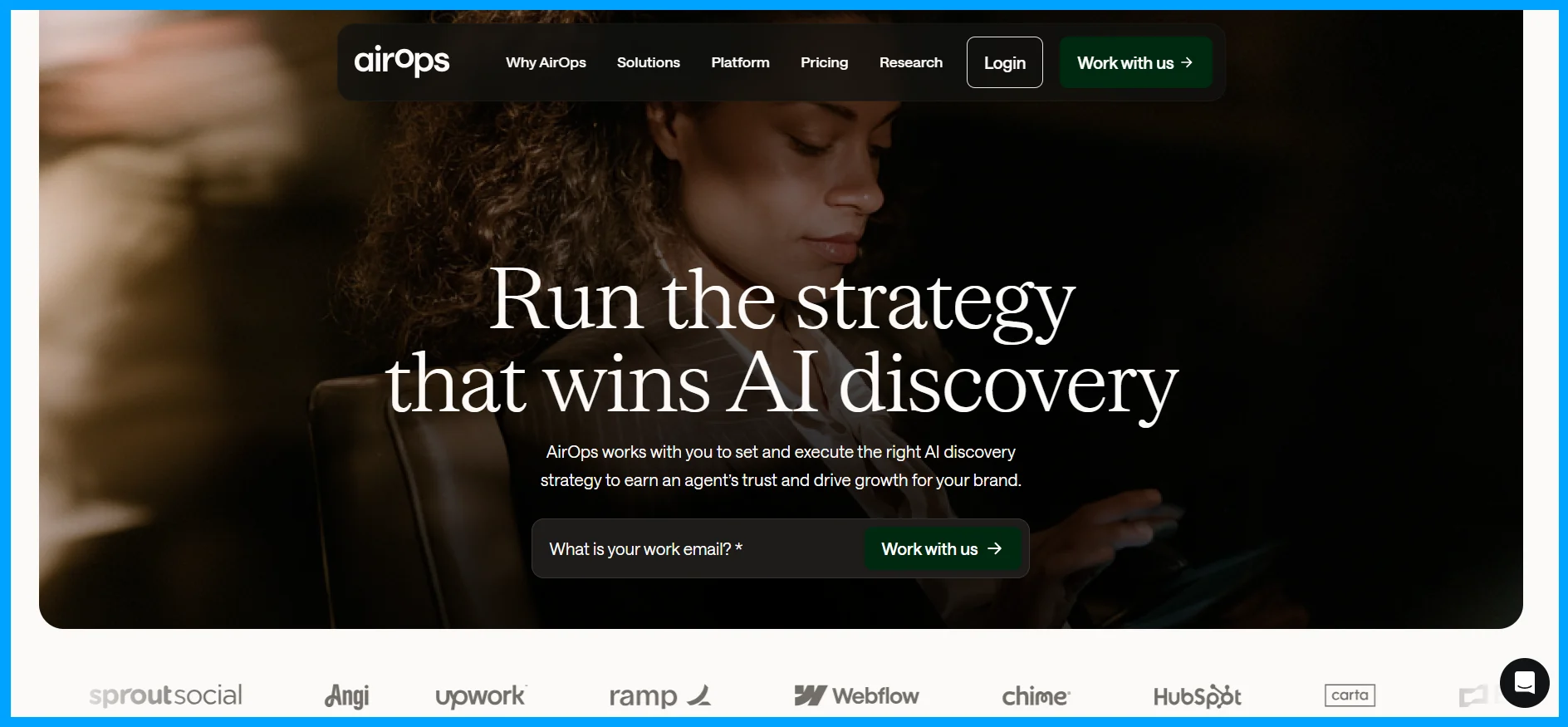
AirOps is the Profound alternative I'd pick for most teams because it covers both what Profound gives you and the step Profound leaves to you: acting on the data. AirOps Insights show how often ChatGPT, Gemini, Perplexity, Google's AI features, and other answer engines mention and cite your brand, and Page360 adds your Google Search Console, GA4, and other integration tools’ data to enrich the overview of your brand’s performance. Then Workflows, Playbooks, and Grids turn that data and findings into strategy, briefs, drafts, and refreshes across hundreds of pages, and the Quill agent proposes fixes for your team to approve.
Workflows, Playbooks, and Grids are my favorite AirOps features because they turn repetitive tasks into automated processes, and Grids makes it easier to run those processes at scale. For instance, for my SEO and content marketing work, I used Insights to track the state of my performance on answer engines, used Page360 to add further context, and then used a playbook to develop a data-enriched content strategy. What usually takes me about two weeks or more of research, data gathering, and writing took me hours to execute. My success story with Quill was featured by AirOps (opens in a new tab) around its launch.
AirOps pricing
AirOps sells Solo, Pro, and Enterprise plans and doesn't publish dollar prices; however, my investigation shows Solo starts at about $200. Solo includes 35,000 tasks a month for one user, with ChatGPT insights only. Pro includes 100,000 tasks, unlimited seats, and insights across 10+ answer engines. Extra tasks on Solo cost $0.025 each. The 14-day free trial needs no card and comes with 50,000 free credits for testing workflows. You can check the AirOps pricing pag (opens in a new tab)e (opens in a new tab) for more.
What users say about AirOps
AirOps holds 4.7/5 from 134 reviews on G2 as of October 2026. Reviewers praise the time it saves on research and drafting and the way Grids refresh pages at scale; the most common complaint is the learning curve. AirOps started a free AirOps University (opens in a new tab) to make learning how to use AirOps easier, and you graduate as a content engineer.
AirOps: pros and cons
Pros
- Pro: Connects AI visibility data to action: find the gaps in Insights and Page360, then fix them with workflows, Grids, and Quill
- Pro: Refreshes hundreds of pages with one workflow, which matters because answer engines favor fresh content
- Pro: Brand Kits and Knowledge Bases keep AI drafts in your brand's voice and grounded in your own material
- Pro: Publishes straight to WordPress, Webflow, Contentful, and Sanity
- Pro: Free 14-day trial with no card, and free training through AirOps University
Cons
- Con: Solo tracks ChatGPT only; you need Pro for Google AI Overviews, Perplexity, and other engines
- Con: A real learning curve: plan on a few weeks to set up your context and first workflows
- Con: More than you need if you only want a dashboard of AI visibility numbers
My take on AirOps as a Profound alternative
If your team publishes or refreshes content regularly, AirOps gives you more for your money than a tracker alone, because the same tool that finds the gap helps you close it. Start with the free trial, connect Search Console and GA4, and run one refresh workflow on ten pages that rank in Google but don't get cited in AI answers. For the full breakdown, read my extensive AirOps review.
2. Peec AI: the best focused tracker for brands and agencies
Peec AI
Best focused trackerA Berlin-based AI search analytics tool that tracks your visibility, position, and sentiment in AI answers, shows which sources those answers cite, and benchmarks you against competitors.
- Best for
- Brands and agencies that want daily AI visibility tracking with unlimited seats
- Price
- From $95/month (Starter, 50 prompts)Checked 31 Oct 2026. Prices can change.
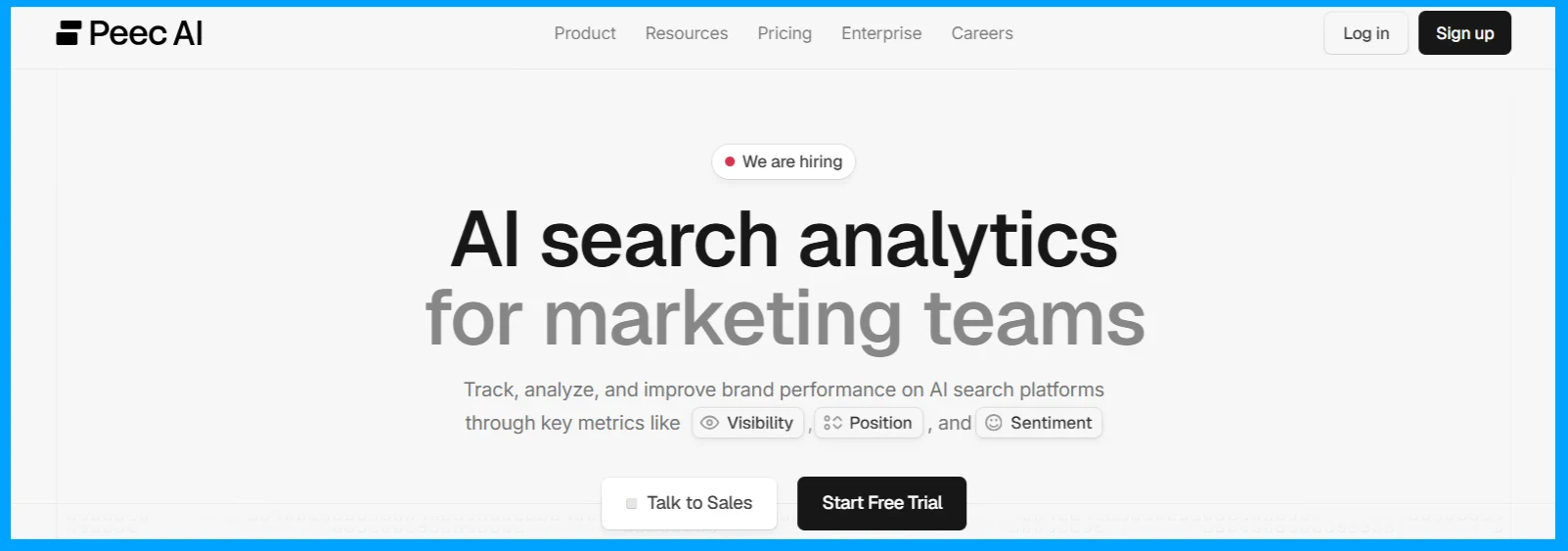
Peec AI is a strong pick if tracking is all you need and Profound's Enterprise pricing is out of reach. The AI visibility tool runs your prompts daily and reports your visibility, position, and sentiment, and its sources view shows which domains AI answers lean on, such as G2, LinkedIn, Reddit, and major publications. That makes it easy to see which third-party sites you need to appear on. Peec also suggests prompts with search volumes, benchmarks you against competitors, and exports to CSV, Looker Studio, an API, and an MCP server.
Peec AI raised a $21 million Series A in November 2025, led by Singular, according to Invest in Berlin (opens in a new tab).
Peec AI pricing
Starter costs $95 a month for 50 prompts and 1 country; Pro costs $245 a month for 150 prompts across 3 countries; Advanced costs $495 a month for 350 prompts. Each of these plans tracks 3 active models, chosen from ChatGPT, Google AI Mode, Google AI Overviews, Microsoft Copilot, Gemini, and Naver AI. Perplexity is listed only on the custom Enterprise plan. Every plan includes unlimited seats and languages, according to Peec AI’s pricing page (opens in a new tab).
What users say about Peec AI
Peec AI has a 4.7/5 G2 rating, but G2 lists only a small number of reviews (21) for it. Across those 21 reviews, I found Peec AI is praised for its clean, intuitive interface, easy setup, reliable AI visibility and prompt tracking, competitor analysis, and detailed citation and source tracking across LLMs. The reviewers also appreciate its actionable analytics, flexible project setup, MCP integration, API, and responsive support. On the flip side, some users want clearer recommendations for improving AI visibility, more reliable content recommendations, better prompt optimization to reduce overlapping prompts, additional AI model coverage across pricing tiers, and more affordable pricing. Others mention limited page-level AEO optimization capabilities and difficulty attributing improvements in AI visibility to specific actions.
Peec AI: pros and cons
Pros
- Pro: Clear, published prices from $95 a month
- Pro: Unlimited seats and languages on every plan
- Pro: Shows which source domains AI answers cite, so you know where to earn mentions
- Pro: Looker Studio connector, API, and MCP server for reporting
Cons
- Con: Only 3 active AI models on self-serve plans
- Con: Perplexity is listed only on the Enterprise plan
- Con: Recommends what to do, but doesn't write or publish content for you
My take on Peec AI as a Profound alternative
Choose Peec AI if you want a clean, affordable tracker and you already have writers who can act on the data. If you'd rather your tool helped with the execution part (content writing, refreshing, and publishing at scale) and helped you track and attribute improvements in AI visibility to specific actions, AirOps is for you (opens in a new tab).
3. Otterly.AI: the cheapest Profound alternative
Otterly.AI
Best budget pickAn AI search monitoring tool that tracks brand mentions and link citations in AI answers, with a content audit that checks why AI engines skip your pages.
- Best for
- Small teams, freelancers, and first-time trackers on a tight budget
- Price
- From $29/month (Lite, 15 prompts)Checked 31 Oct 2026. Prices can change.
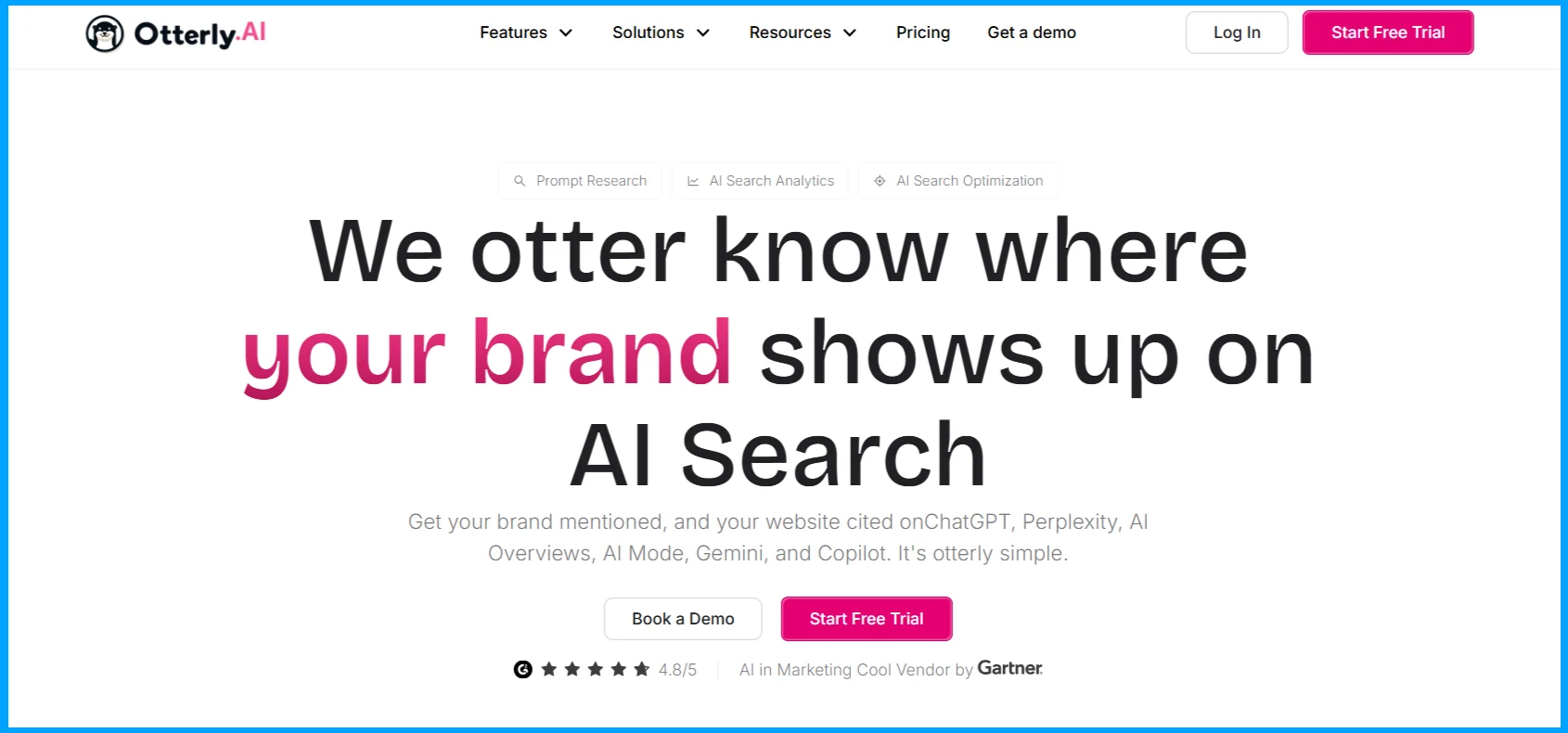
Otterly.AI is the cheapest way to start tracking AI visibility. Its Lite plan costs $29 a month and covers ChatGPT, Google AI Overviews, Perplexity, and Microsoft Copilot, which is enough to see whether AI answers mention you at all. Beyond prompt monitoring, Otterly tracks the links AI answers cite, analyzes sentiment, sends alerts when your mentions change, and includes a content audit that checks crawlability and scores how likely AI engines are to use a page.
Otterly.AI was one of just five vendors featured in (opens in a new tab) the 2025 Gartner 2025 Cool Vendors in AI Marketing report.
Otterly.AI pricing
Otterly.AI Lite costs $29 a month for 15 prompts; Standard costs $189 a month for 100 prompts and adds an API, MCP, and Agent Analytics; Premium costs $489 a month for 400 prompts. Google AI Mode, Gemini, and Claude are paid add-ons on every plan: on Lite, AI Mode and Gemini cost $9 a month each, and Claude costs $29 a month. The annual billing is cheaper, every plan includes unlimited team members, and Otterly.AI offers a free trial you can use to check if the product is a good fit
What users say about Otterly.AI
Otterly.AI has a 4.7/5 average G2 rating from about 54 reviews as of October 2026. The AI visibility tool is praised for its intuitive, easy-to-use dashboards, actionable GEO recommendations, AI search visibility tracking, competitor monitoring, and time-saving insights that help teams improve their AI search presence. Some reviews also appreciate its pricing and return on investment, which makes sense considering it’s the cheapest Profound alternative on our list.
For now, the available reviews do not establish a recurring product weakness. On my further digging, I discovered complaints about limited data for niche industries, lack of website integrations and direct traffic attribution, limited advanced filters and reporting customization, less granular historical data, occasional data refresh delays, and a Content Generator that could benefit from contextual brand memory.
Otterly.AI: pros and cons
Pros
- Pro: The lowest entry price here: $29 a month
- Pro: Four major AI engines included from the cheapest plan
- Pro: Content audit explains why AI engines might skip a page
- Pro: Unlimited team members on every plan
Cons
- Con: Only 15 prompts on Lite, which runs out fast
- Con: Gemini, Google AI Mode, and Claude cost extra
- Con: The jump from Lite ($29) to Standard ($189) is steep
- Con: Doesn't create or refresh content for you
My take on Otterly.AI as a Profound alternative
Otterly.AI is my recommended first step if you've never tracked AI visibility and want to learn what's happening before you spend more on a bigger tool. Once you know where you're missing, you'll need a way to fix it, and that's where a platform like AirOps comes in.
4. Semrush One: the best Profound alternative for Semrush users
Semrush One
Best for Semrush usersSemrush's combined plan, launched on October 29, 2025, that adds AI visibility tracking to its traditional SEO toolkit, so you can track Google rankings and AI answers in one place.
- Best for
- SEO teams and agencies that already use, or want, Semrush for traditional SEO
- Price
- From $199/month ($165.17/month billed annually)Checked 31 Oct 2026. Prices can change.
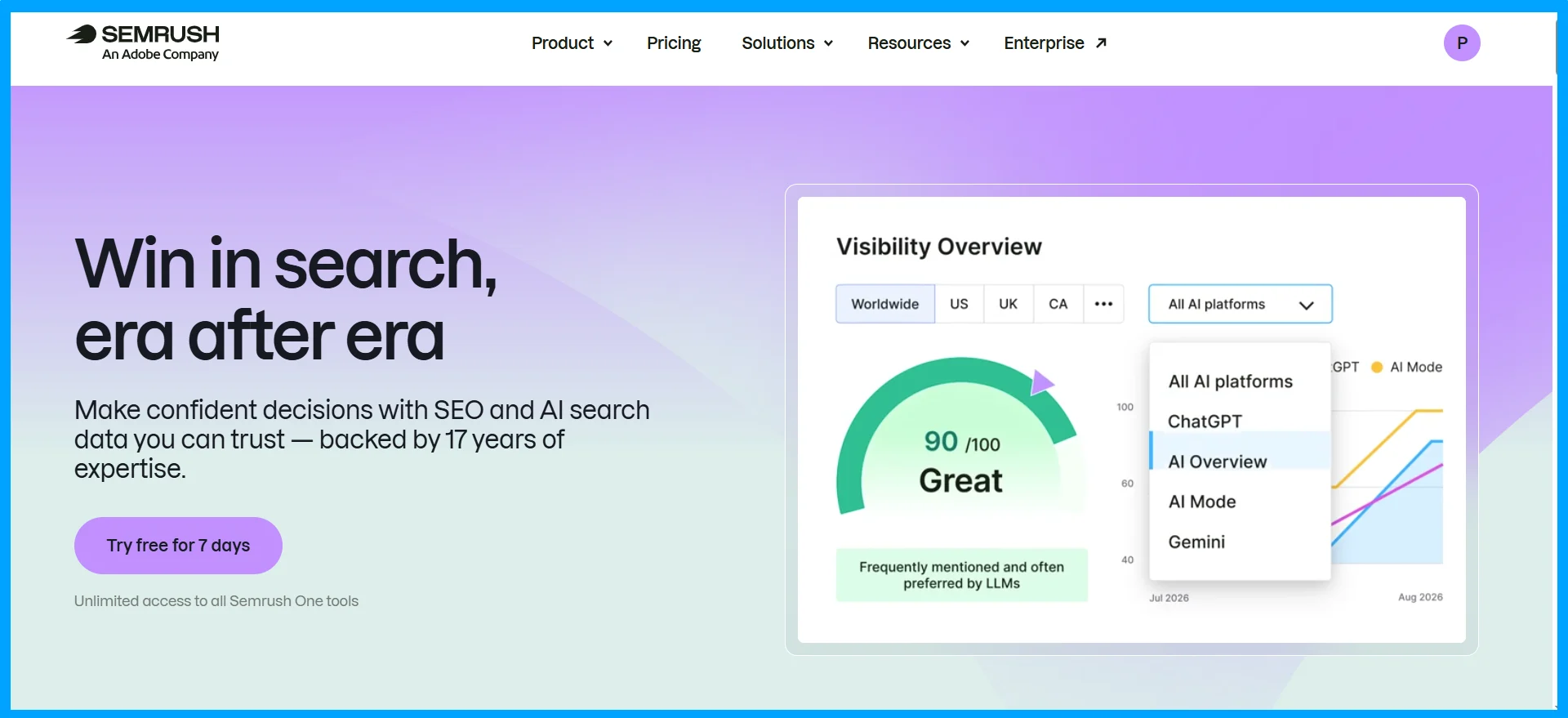
Semrush One makes the most sense if you already pay for Semrush or want one subscription for both SEO and AI search. Semrush describes it as uniting "traditional SEO and AI Search into a single offering." That way, the keyword research, content research, domain overview, site audits, and position tracking you know sit next to AI visibility reports, AI sentiment, and daily prompt tracking across Google, ChatGPT, Perplexity, and Gemini.
I’ve been using Semrush for more than 5 years and can attest to how extensive its SEO data can be. I’ve also used its AI visibility tool since it was launched, and the data has been insightful, though not as extensive as the SEO data.
A quick mention here that Semrush itself is now part of Adobe, which announced on April 28, 2026, that it had completed its acquisition of Semrush.
Semrush One pricing
Starter costs $199 a month, or $165.17 a month billed annually, for 5 websites, 500 keywords tracked daily, and 50 prompts tracked daily. Pro+ costs $299 a month, or $248.17 a month billed annually, for 15 websites, 1,500 keywords, 100 prompts, and content optimization tools. Advanced starts at $455.67 per month when priced annually, but $549 per month when you pay per month. There's also a 7-day free trial you can use on the Starter and Pro+ plans.
What users say about Semrush One
Semrush is one of the most-reviewed SEO platforms on G2; however, Semrush One's AI features are newer and have little to no mention in the reviews. Semrush itself has 4.4/5 from 4,303 reviews, but then I’d be unfair to compare that to other tools on this list. So when I read the reviews, I focused on those that mentioned Semrush One or the visibility tool. I found that reviewers appreciate the AI Visibility Score, brand mention and citation tracking, share-of-voice insights, prompt research, and visibility monitoring across ChatGPT, Google AI Overviews, Gemini, and Perplexity. They find the dashboards intuitive and actionable. However, common complaints include expensive add-ons, limited prompt-tracking quotas, extra token requirements, restricted platform coverage, and sometimes inaccurate or irrelevant prompt-gap data.
Semrush One: pros and cons
Pros
- Pro: SEO and AI visibility in one subscription and one interface
- Pro: Published prices and a 7-day free trial
- Pro: Keyword, audit, and content tools to act on what you find
- Pro: Daily prompt tracking from the Starter plan
Cons
- Con: Only 50 prompts on Starter and 100 on Pro+
- Con: Expensive if you only need AI visibility tracking
- Con: AI visibility is one part of a large suite, so it's less deep than a dedicated platform
- Con: Content tools support writers rather than writing and publishing for you
My take on Semrush One as a Profound alternative
Pick Semrush One if Semrush is already your team's SEO home and you want AI tracking without another login. If AI search is your main focus, a dedicated platform gives you more prompts and more depth for the money. If you want a platform that both tracks and helps you automate on-brand content writing, updating, and posting at scale, it’s AirOps.
5. Scrunch: the closest enterprise match to Profound
Scrunch
Best for enterprise brandsAn AI experience platform that monitors your brand across AI engines by prompt, topic, persona, and region, tracks AI bot traffic to your site, and serves AI agents a machine-readable version of your pages.
- Best for
- Enterprise brands and agencies that want Profound-level depth
- Price
- From $300/month ($250/month billed annually)Checked 31 Oct 2026. Prices can change.
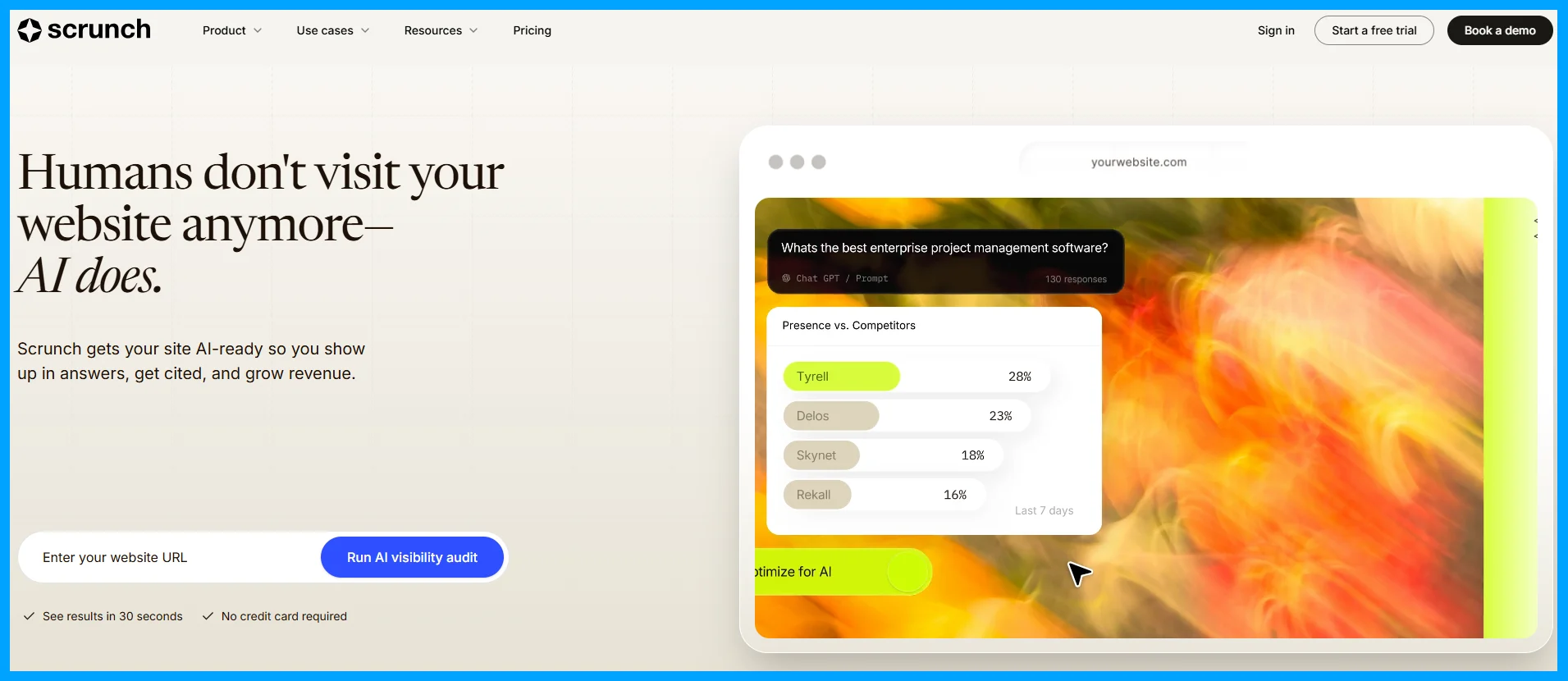
Scrunch is the most direct replacement if you want enterprise-grade monitoring without starting with a sales call. It tracks prompts, topics, and entities across ChatGPT, Claude, Gemini, Perplexity, Google AI Mode and AI Overviews, and Meta, and lets you benchmark by competitor, persona, topic, and region. Two features stand out for me: an AI traffic view that shows how AI bots crawl your site, and its Agent Experience Platform (AXP), which creates a lightweight version of your site written for AI agents while keeping the design people see.
I’d mention here that Sitecore, the digital experience platform, announced its acquisition of Scrunch (opens in a new tab) on June 3, 2026.
Scrunch pricing
Core costs $250 a month for 1 brand workspace, 125 custom prompts, 5,000 responses, 5 audits, 5 user licenses, and 4 LLMs (ChatGPT, Perplexity, Google AIO, and Copilot) supported. Enterprise is custom-priced. The Core plan has a 7-day free trial with no card required, according to the Scrunch pricing page (opens in a new tab).
What users say about Scrunch
People like Scrunch's intuitive interface, actionable AI visibility insights, competitor tracking, custom prompts, and responsive support. However, some reviews I read point to bugs in GA4 integrations, limited reporting and exports, imperfect sentiment analysis, and delayed monitoring across newer AI platforms. It's a promising product, but there's still room to improve.
Scrunch: pros and cons
Pros
- Pro: Published price on Core plan and a 7-day free trial with no card
- Pro: Persona and regional benchmarking, plus AI bot traffic monitoring
- Pro: AXP serves AI agents a machine-readable version of your site
Cons
- Con: The most expensive entry price after Profound
- Con: The Enterprise plan need you to talk to them
- Con: Its roadmap may change as it has become part of Sitecore
My take on Scrunch as a Profound alternative
Choose Scrunch if you're an enterprise brand that wants Profound's depth with published pricing, or if you already run your site on Sitecore. Smaller teams will get more value from the other tools.
Why your choice of AI visibility tool matters
Your choice of AI visibility tool matters because AI answers are now where many buyers stop their search. About 80% of consumers rely on zero-click results, such as AI overviews and chatbot answers, for at least 40% of their searches, according to Bain & Company's Goodbye Clicks, Hello AI: Zero-Click Search Redefines Marketing (opens in a new tab). (opens in a new tab)
Those AI answers change often, according to diverse reports, including AirOps' The 2026 State of AI Search (opens in a new tab) that showed that only 30% of brands stayed visible from one AI answer to the next, and just 20% stayed present across five runs of the same prompt.
The volatility of AI answers and the number of engines to be tracked make it overwhelming to track different prompts manually. Besides, a one-off check tells you very little, so you need a tool that tracks prompts daily and ideally one that helps you act on what it finds.
At the moment, these AI visibility tools aren’t perfect, but they make it much easier to keep an eye on how you’re performing across the different AI answer engines. For a tool like AirOps, you can also get to fix your performance right inside the tool.
How to choose the right Profound alternative
The right AI visibility tool for you depends on what you'll do with the data. Ask these four questions:
- Will you act on the data, and who will do it? If you have writers and an SEO lead with time to spare, a tracker such as Peec AI or Otterly.AI may be enough. If you need the tool to help produce and refresh content at scale, choose AirOps.
- Which AI engines do your buyers use? Check what each entry plan covers. AirOps Solo tracks ChatGPT only, Peec AI's self-serve plans track 3 models, and Otterly.AI charges extra for Gemini, Google AI Mode, and Claude. You need to consider these.
- How many prompts do you need? Count the questions your buyers actually ask across products and regions. Most brands need 50 to several hundred prompts; consider that while making your choice.
- Do you already pay for an SEO suite? If it's Semrush, Semrush One might be an easier-to-onboard and use tool.
Which Profound alternative should you choose?
Verdict: AirOps
Recommended with caveatsAirOps is the best Profound alternative for teams that want to improve their AI visibility, not only measure it. It tracks your brand across 10+ answer engines on Pro, then helps you strategize, brief, write, refresh, and publish the content that closes the gaps, with the Quill agent doing much of the work. It isn't the cheapest tracker; AirOps prices start at $200, and it takes a few days to a week to master the platform.
- Best for
- Content and SEO teams that publish or refresh content regularly and want AI visibility data and content production automation in one tool
- Avoid if
- You only want a low-cost dashboard of AI mentions, or nobody on your team has time to set up workflows
Choose AirOps if you want one platform that shows where AI answers miss you and helps your team fix it at scale.
Choose Otterly.AI if you're on a tight budget and want to start tracking ChatGPT, Google AI Overviews, Perplexity, and Copilot for $29 a month.
Choose Peec AI if you want a focused daily tracker with unlimited seats, and your writers will act on the data.
Choose Semrush One if your team already uses Semrush for SEO and wants AI tracking in the same place.
Choose Scrunch if you're an enterprise brand that wants Profound-level monitoring with transparent pricing.
What I recommend to help you get started: take the AirOps free trial, connect Search Console and GA4, set up Brand Kit and Knowledge Base, and start exploring the different features. You can pick ten pages that rank on Google but aren't cited in AI answers, build a content refresh workflow and run on them, and compare the results after two weeks. If you only want to measure for now, start with Otterly.AI's $29 plan.
Frequently asked questions about Profound alternatives
What is the best alternative to Profound?
AirOps is the best Profound alternative for most content and SEO teams because it tracks AI visibility and helps you create and refresh the content that improves it. For tracking only, Otterly.AI is the cheapest option, from $29 a month, and Peec AI is a strong focused tracker from $95 a month.
How much does Profound cost?
Profound's pricing page lists a free seven-day trial (50 prompts across ChatGPT, Gemini, and Google AI Overviews) and custom Enterprise pricing for brands, plus a self-serve Agency Growth plan with no published price.
Is there a free alternative to Profound?
None of these tools is free long term, but most offer a trial. AirOps offers 14 days with no card required, Scrunch and Semrush One offer 7 days, and Otterly.AI offers a free trial. Otterly.AI's paid plans start at $29 a month.
Which Profound alternative tracks the most AI engines?
AirOps Pro covers the most, with insights across 10+ answer engines, though AirOps Solo tracks ChatGPT only. Scrunch tracks seven engines on every plan: ChatGPT, Claude, Gemini, Perplexity, Google AI Mode and AI Overviews, and Meta. Profound's Enterprise plan covers up to nine.
Can AirOps replace Profound?
Yes, for most teams. AirOps Pro tracks your visibility across 10+ answer engines like Profound does, and adds content workflows, Grids for refreshing pages at scale, and the Quill agent. Profound's Enterprise plan goes deeper on some analytics, such as ChatGPT Shopping and prompt volumes.
Is Semrush One a good Profound alternative?
It's a good alternative if your team already uses Semrush for SEO. Semrush One adds daily prompt tracking across Google, ChatGPT, Perplexity, and Gemini from $199 a month, but with 50 prompts on Starter it's less deep than a dedicated AI visibility platform.
Sources
- Profound: Pricing (opens in a new tab) (checked October 31, 2026)
- Fortune: Profound raises $96 million Series C (exclusive) (opens in a new tab) (February 24, 2026)
- The Next Web: Profound raised $180m at a $1.8bn valuation to sell brands visibility in AI answers (opens in a new tab) (September 2026)
- G2: Profound reviews (opens in a new tab) (checked October 31, 2026)
- AirOps: Pricing (opens in a new tab) (checked October 31, 2026)
- AirOps: The 2026 State of AI Search (opens in a new tab) (December 2, 2025)
- G2: AirOps reviews (opens in a new tab) (October 2026)
- Peec AI: Pricing (opens in a new tab) (checked October 31, 2026)
- Berlin Partner: Berlin's Peec AI secures $21m for AI search tools (opens in a new tab) (November 18, 2025)
- Otterly.AI: Pricing (opens in a new tab) (checked October 31, 2026)
- Semrush: Semrush Launches Semrush One, Empowering Marketers to Win Every Search in the AI Era (opens in a new tab) (October 29, 2025)
- Semrush: Pricing (opens in a new tab) and Semrush One vs SEO Toolkit (opens in a new tab) (checked October 31, 2026)
- Scrunch: Pricing (opens in a new tab) (checked October 31, 2026)
- Sitecore: Sitecore acquires Scrunch to help brands influence discovery and buying decisions in the AI-search era (opens in a new tab) (June 3, 2026)
- Bain & Company: Goodbye Clicks, Hello AI: Zero-Click Search Redefines Marketing (opens in a new tab) (February 19, 2025)