An AI content operations platform is software that runs your content work as a system: it holds your brand context, automates the repeatable steps from research to publishing, keeps humans in the loop for review, and measures what the content does after it goes live. That's different from an AI writing assistant you open for one blog post.
Whenever I think of the best AI content operations tool, I think of AirOps because it’s reliable, and I’ve used it for about a year on my own brand and for client accounts. I’ve helped businesses of all sizes set up their AirOps account, so I know where it fits and where it doesn’t. To cover more tools, I dug deep to put this list together. I compare 5 AI content operations platforms: their features, pricing, security, who they’re perfect for, and who they might be overkill for.
Best AI content operations platforms: key takeaways
- Best overall: AirOps. It tracks your brand across 10+ AI answer engines, adds your Search Console and GA4 data to each page, and runs the workflows that brief, write, refresh, and publish the content to close the gaps. Free 14-day trial, no card required.
- Best for brand-governed campaign content: Jasper, with Brand IQ, marketing agents, Jasper Grid for adapting campaigns across regions and 27 languages, and, since June 2026, a GEO Agent and GEO Hub for AI search. Pro costs $69 per seat a month; Business is custom.
- Best for regulated industries and company-wide AI agents: WRITER, with its own Palmyra models, ISO 27001 and 42001 certifications, and a SOC 2 Type II audit that includes HIPAA.
- Best for personalized multichannel campaigns: Typeface' Arc platform turns brand guidelines into rules that its agents enforce across ads, email, web, and creative tools.
- Best for planning, approvals, and assets: Optimizely Content Marketing Platform, a Gartner Magic Quadrant Leader for content marketing platforms for nine years running, now with Opal AI agents built in.
How I chose and tested these AI content operations platforms
I've used AirOps for about a year on the Pro plan. But then, I understand there are other AI content operations tools out there. I investigated the top options, asking questions, digging into their product information and demo videos, etc to uncover information that they don’t usually publish online.
For all five platforms, I went through their official pricing and product pages, security and trust pages, launch announcements from the past 12 months, and reviews from top review platforms. I judged every platform on the same seven things a mid-size or large company cares about when choosing a platform for automating content operations:
- Brand context and governance: Can it learn your voice, tone, products, and rules and enforce them effectively?
- Workflow automation at scale: Can it run the same process across hundreds of pages or assets?
- Human review: Can you add approval steps before anything goes live?
- AI search visibility: Does it show how your website is performing on AI search platforms?
- Integrations and publishing: Does it connect to your CMS, analytics, and the tools your team already uses?
- Security and admin: SOC 2, SSO, role-based access, and a clear policy on training models with your data.
- Pricing clarity and user sentiment: What you can learn before a sales call and what users say.
I purposely left out single-purpose AI writers, which don't run workflows or governance, and AI visibility trackers that don't help you produce content. If tracking is all you need, head over and read my guide to Profound alternatives. You'll find the full list of sources at the end.
What is an AI content operations platform?
An AI content operations platform is software that combines your brand knowledge, AI models, automated workflows, and human review in one place, so a team can plan, produce, refresh, govern, and measure content at scale. This approach is called "content engineering": building repeatable systems instead of relying on one-off prompts.
It helps to see where these platforms sit next to the tools you probably already have:
Tool type | What it does | Examples | What it doesn't do |
|---|---|---|---|
AI writing assistant | Drafts one piece at a time from a prompt | ChatGPT, Claude, Gemini | Hold your brand rules, run multi-step workflows, or track results |
AI content operations platform | Runs repeatable AI workflows with brand context, review steps, and publishing | AirOps, Jasper, WRITER, Typeface | Replace your CMS or your editors |
Content marketing platform | Plans campaigns, routes work and approvals, and stores assets | Optimizely CMP | Write at scale without its AI add-on (Opal) |
CMS | Stores and publishes your website content | WordPress, Webflow, Contentful, Sanity | Plan, write, or measure content results |
AI visibility tracker | Monitors how AI answers mention and cite your brand | Profound, Peec AI | Create or fix the content |
To be honest, the lines are blurring because different platforms are adding features to improve their offering: Jasper now has a GEO agent, Optimizely has AI agents, and AirOps tracks AI visibility. So this raises the questions of which part of the content process slows your team down most, which parts can be automated, and which tools can offer the most end-to-end value with the needed governance.
The best AI content operations platforms at a glance
Platform | Best for | Starting price | AI search visibility | Custom agents or workflows | Publishes to your CMS | Free trial |
|---|---|---|---|---|---|---|
AirOps | Content and SEO teams that publish and refresh at volume and want to win AI search | Not on its pricing page, but I found the plan starts at Solo from $200/month. | Yes: ChatGPT on Solo, 10+ engines on Pro | Yes: Workflows, Playbooks, Grids, and the Quill agent | Yes: WordPress, Webflow, Contentful, Sanity, Drupal, and Prismic | 14 days, no card |
Jasper | Large marketing teams that need on-brand campaign content in many languages | Pro: $69/seat/month ($59 billed annually). | Yes: GEO Hub and GEO Agent (GEO agent on Business) | Yes: AI Studio custom agents and Jasper Grid (Business) | Through APIs, MCP, and integrations | 7 days (Pro) |
WRITER | Regulated enterprises that want governed AI agents across many teams | Starter: $39/user/month, or $29 billed annually | No dedicated tracker | Yes: AI HQ agent builder and Playbooks | Through integrations and APIs | Starter trial |
Typeface | Enterprise brands running personalized campaigns across many channels | Custom (demo only) | No dedicated tracker | Yes: Arc Fabric agents and reusable skills | Through MCP, APIs, and martech integrations | Product tour, no trial listed |
Optimizely CMP | Enterprise marketing teams that need planning, approvals, and asset management | Custom (individually packaged) | GEO recommendations agent | Yes: 50+ ready-made Opal agents, or build your own | Yes: to Optimizely CMS and other CMS tools | No trial listed |
1. AirOps: the best AI content operations platform overall
AirOps
Best overallA content engineering platform that tracks how AI answer engines cite your brand, then runs AI workflows, grids, and the Quill agent to brief, write, refresh, and publish the content that closes the gaps, with human review at every step.
- Best for
- In-house content and SEO teams at mid-size and large companies that publish or refresh dozens of pages a month
- Price
- Free 14-day trial; I found Solo from $200/month and Pro from $2,000/monthChecked 31 Oct 2026. Prices can change.
AirOps is my top pick because it ties content production more closely to search results than any other platform here. Most content operations tools’ features only go as far as content publishing. AirOps starts before that, with AI visibility data showing where you're missing out, and keeps going after content is published by tracking whether the update earned citations and clicks. Jasper added AI visibility tracking to its features in June 2026, but for website content, I’d still go with AirOps. AirOps enables you to integrate data from your Google Search Console (GSC), Google Analytics 4 (GA4), and tons of other platforms where your data live. You can also refresh hundreds of pages in one batch and publish natively to six CMS platforms.
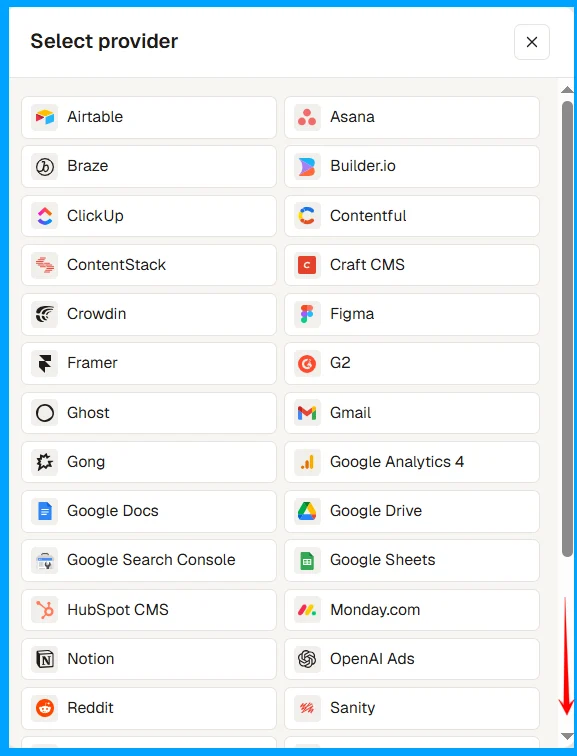
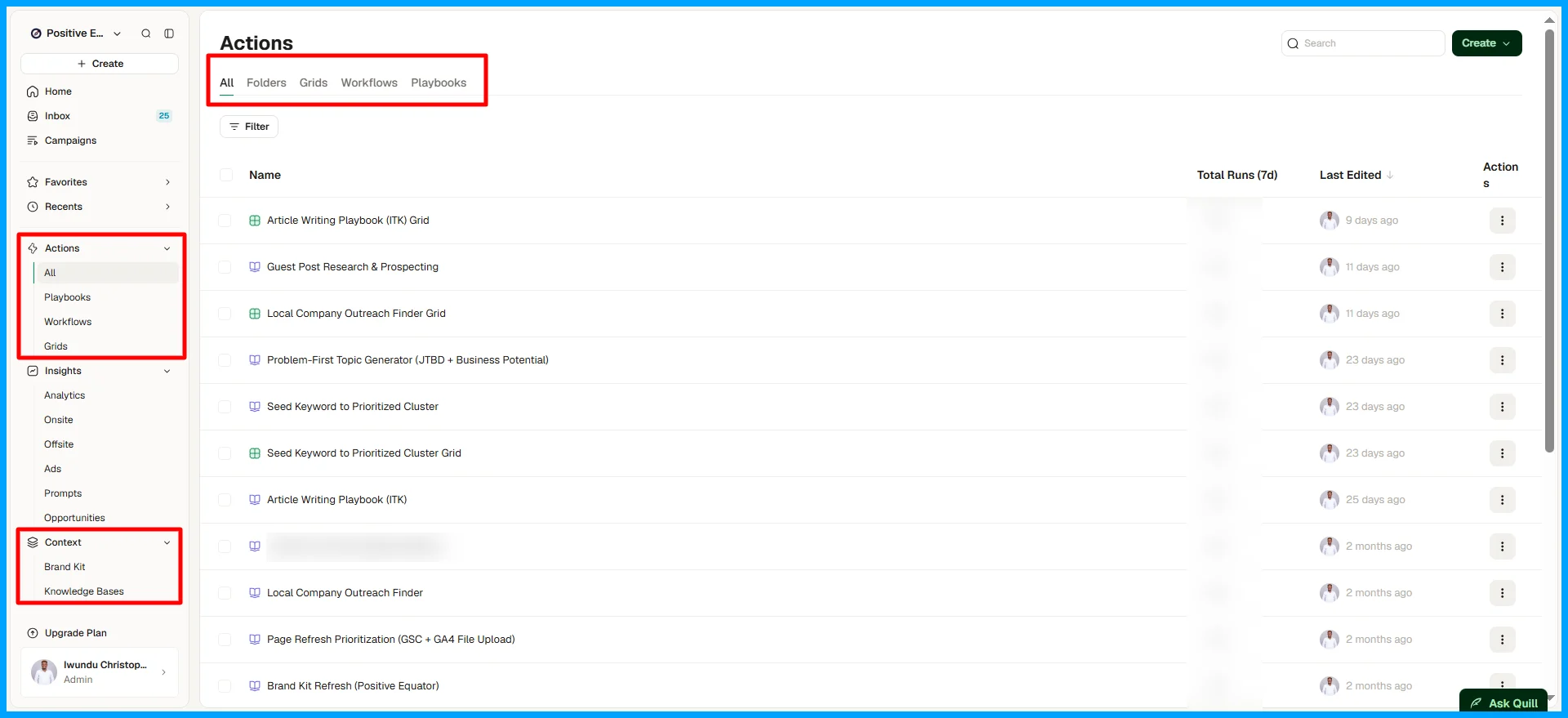
Here's how the pieces fit together:
- Insights and Page360 show how often ChatGPT, Gemini, Perplexity, Google's AI features, and other answer engines mention and cite you, and add your Google Search Console and GA4 data to each page. That's how you find pages that rank on Google but never get cited in AI answers (opens in a new tab).
- Workflows and Playbooks turn repeatable work, such as content briefs, drafts, refreshes, and internal linking, into multi-step AI processes that use the models you choose, including models from OpenAI, Anthropic, Google, and Perplexity.
- Grids run one workflow across hundreds of rows at once, so a refresh that would take a team weeks runs in one batch.
- Brand Kits and Knowledge Bases hold your voice, author persona, positioning, products, and source material, so drafts sound like you and stay grounded in your facts.
- Quill, the AI agent, watches for stale pages, competitor gaps, and prompts where you aren't cited, then drafts fixes for your team to approve.
- Offsite finds and reports the third-party sites, forums, and communities that AI answers pull from, so you can earn mentions there too.
Over the months using AirOps, I’ve built several SEO and content workflows that have helped me automate most of my manual tasks, cutting down my operations time from 3-5 days to about 3-5 hours and improving my efficiency by up to 80%.
Why AirOps fits mid-size and large companies
When I reviewed AirOps' (opens in a new tab)enterprise page (opens in a new tab), I saw that it lists SOC 2 Type II certification with annual penetration testing, SSO through Okta, Azure AD, and Google Workspace, and role-based access control and SCIM provisioning on enterprise plans. You can add human review checkpoints at any workflow stage and hold content in draft until it's approved. The page also says your prompts, inputs, and brand data are never used to train AirOps models or third-party models, and that data is purged within 30 days of a contract ending. AirOps also publishes natively to WordPress, Webflow, Contentful, Sanity, Drupal, and Prismic, with an API for custom CMS setups.
It answers every question or concern an enterprise might have before onboarding with an AI content operations platform.
Results from AirOps customers
I went further to check results from mid- to large companies using AirOps and found impressive results like this one from AirOps' Webflow case study (opens in a new tab) published in June 2026. Webflow increased its content refresh speed 5x and grew ChatGPT-attributed signups from 2% to nearly 10%. AirOps' enterprise page also says Carta saw a 7x increase in AI search citations. Other companies on its customer lineup include Ramp, Chime, HubSpot, Carta, Wiz, KAYAK, monday.com, and Canva.
AirOps Pricing
AirOps sells Solo, Pro, and Enterprise plans and doesn't show dollar prices on its pricing page. However, while researching for my extensive AirOps review, I found that Solo starts at $200 a month, Pro at $2,000 a month, and the Enterprise plan is custom. Each plan has a 14-day free trial that needs no card and includes 50,000 credits for testing workflows.
Solo includes 35,000 tasks a month for one user, with ChatGPT insights only. Pro includes 100,000 tasks, unlimited seats, and insights across 10+ answer engines. Enterprise adds custom task, prompt, and page limits, unlimited Brand Kits and Knowledge Bases, custom agent builds, a dedicated account manager, and 1:1 expert onboarding.
What users say about AirOps
AirOps holds 4.7/5 from 134 reviews on G2 as of October 2026. Reviewers praise the time saved on research and drafting and the way Grids refresh pages at scale. The most common complaints are the learning curve and costs that are hard to predict before you've run your own workflows.
AirOps: pros and cons
Pros
- Pro: Connects AI visibility data to production: find gaps in Insights and Page360, then fix them with workflows, Grids, and Quill
- Pro: Grids refresh or create hundreds of pages with one workflow
- Pro: Enterprise controls: SOC 2 Type II, SSO, role-based access, SCIM, and review checkpoints before publishing
- Pro: Publishes straight to WordPress, Webflow, Contentful, Sanity, Drupal, and Prismic
- Pro: Free 14-day trial with no card, and free training through AirOps University
Cons
- Con: A real learning curve. You have to take the time to setup your account and learn how to maximize use of the platform.
- Con: Built for written web content, not for campaign calendars, digital asset management, or video
- Con: Solo tracks ChatGPT only, so most companies will need Pro or Enterprise
My recommendation
If your content team's main job is growing organic and AI search traffic from a large website, AirOps gives you the most for your money because the platform that finds the problem also fixes it. For the full breakdown, read my AirOps review.
2. Jasper: the best for brand-governed campaign content
Jasper
Best for brand governanceAn AI marketing platform that serves as the AI operating system for enterprise marketing teams, with marketing agents, a brand context layer called Jasper IQ, custom agents in AI Studio, and Jasper Grid for adapting campaigns across regions and languages.
- Best for
- Large marketing teams that produce campaign content across many channels, products, and languages
- Price
- Pro from $69/seat/month ($59 billed annually); Business plan is customChecked 31 Oct 2026. Prices can change.
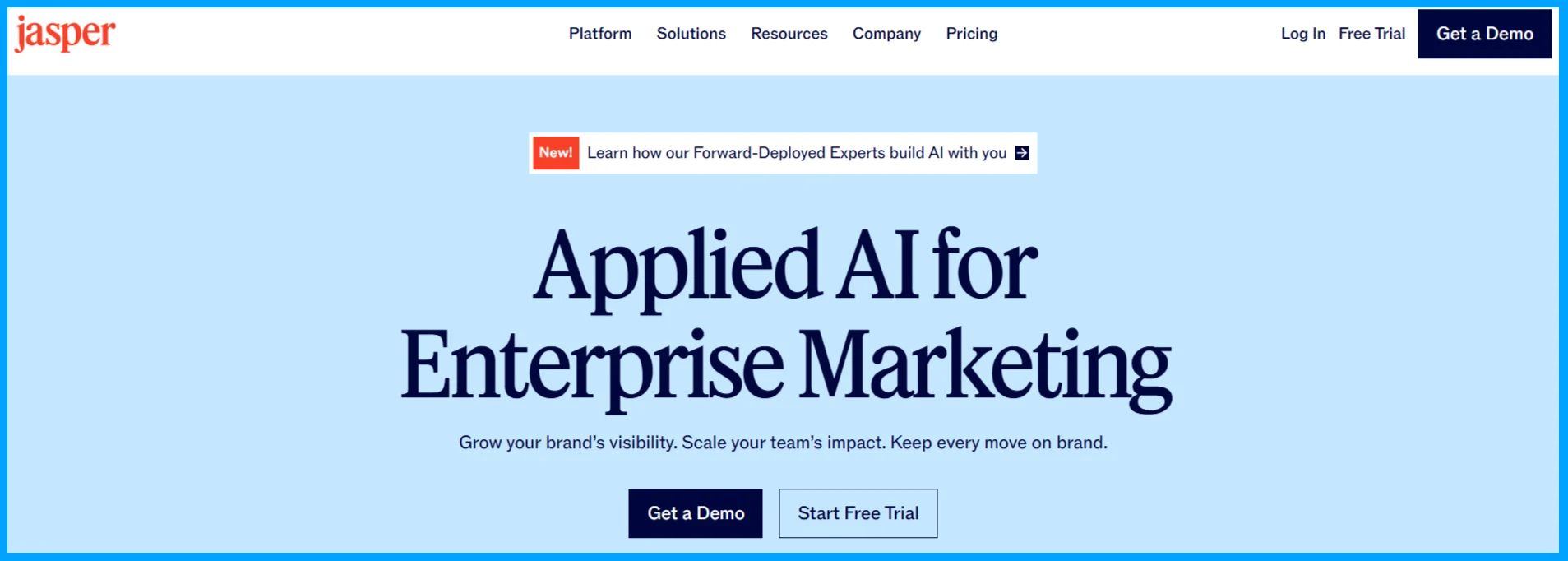
Jasper is the best choice if your bottleneck is keeping a big marketing team on-brand across campaigns, channels, and languages. Its context layer, Jasper IQ, includes Brand IQ (your brand voice, visual guidelines, and style guide), Product IQ, and a knowledge base, so every agent and every writer works from the same rules.
On top of that, Jasper's agents handle end-to-end marketing tasks, including GEO, research, and translation. Jasper’s AI Studio lets you build custom agents without code, and Jasper Grid adapts a campaign for different regions and audiences, including translation into 27 languages. According to Jasper, their customers include Sanofi, Prudential, HarperCollins, Morningstar, Ulta Beauty, and U.S. Bank.
Jasper has also moved into AI search. On June 16, 2026, it launched (opens in a new tab) the GEO Agent and GEO Hub. GEO Hub scores your brand presence, citation rate, sentiment, and share of voice against competitors by topic and by AI model, and the GEO Agent optimizes existing content, creates content where you have little AI presence, and responds to competitor citations. The announcement blog names ChatGPT, Gemini, and Claude as examples, but I couldn’t see a comprehensive list of every engine it tracks.
Jasper Security
According to Jasper, the platform is SOC 2 Type II certified, complies with GDPR and CCPA, encrypts data in transit and at rest, and doesn't use customer data to train AI models. SSO (SAML 2.0) comes with the Business plan.
Jasper Pricing
Jasper Pro costs $69 per seat per month, or $59 billed annually, and includes Canvas, agents for core marketing workflows, 2 Brand Voices, 5 knowledge assets, and 3 audiences. Business is custom-priced with a 12-month commitment and adds the GEO, translation, and deep research agents, the no-code agent builder, Jasper Grid, unlimited Brand Voices, API access, SSO, admin controls, and priority support. There's a 7-day free trial of the Pro plan.
What users say about Jasper
Jasper holds 4.7/5 from 1,274 reviews on G2 as of August 2026, by far the most reviews on this list. Its longer history as an AI writing tool means many reviews describe the older product, but there are a few reviews about the current product offering. Users like Jasper's ease of use, marketing-focused templates, brand voice capabilities, and ability to speed up content creation and repurpose content across channels. However, some of the reviews highlight expensive pricing, generic or repetitive outputs, factual inaccuracies, and the need for substantial human editing. Some also report restrictive credits and billing frustrations.
Jasper: pros and cons
Pros
- Pro: Brand IQ keeps voice, visual guidelines, and style rules consistent across a large team
- Pro: Jasper Grid adapts campaigns for regions and audiences in 27 languages
- Pro: GEO Hub tracks presence, citation rate, sentiment, and share of voice by AI model
- Pro: Published Pro price and a 7-day free trial
- Pro: SOC 2 Type II, SSO on Business, and no training on customer data
Cons
- Con: Grid, custom agents, the GEO agent, API access, and SSO all need the custom-priced Business plan
- Con: Business requires a 12-month commitment
- Con: GEO Hub is new (June 2026), and Jasper doesn't list every AI engine it tracks or any Search Console or CMS connection for it
- Con: Stronger for campaign and marketing copy than for refreshing a large website at scale
My recommendation
Choose Jasper if your content operations problem is brand consistency across campaigns, channels, and markets. If your goal is to grow search and AI search traffic from your website, AirOps is the better fit, although some larger teams run both.
3. WRITER: the best for regulated industries and company-wide AI agents
WRITER
Best for regulated enterprisesAn enterprise AI agent platform, founded in 2020, that runs on its own Palmyra models and lets teams build, run, and supervise AI agents with brand and compliance rules built in.
- Best for
- Enterprises in finance, healthcare, and other regulated industries that want governed AI agents across marketing and other teams
- Price
- Starter self-serve; Enterprise customChecked 31 Oct 2026. Prices can change.
WRITER is the strongest choice when security, compliance, and company-wide use matter as much as marketing content. It builds its own large language models, the Palmyra family, and its AI HQ hub, announced in April 2025, is where teams build, activate, and supervise AI agents. Brand governance tools enforce your voice, terminology, and style rules across what those agents produce.
WRITER has shipped quickly in the past few months. It released Palmyra X6 and a rebuilt agent harness on August 13, 2026, and says the pair cut average cost by about 52% compared with its earlier setup, as reported by CMSWire (opens in a new tab). On September 9, 2026, it introduced Enterprise Brain, a governed context layer shared across teams and agents, in early access for select customers. Some of WRITER’s customers include Accenture, Intuit, Marriott, Uber, and Vanguard.
WRITER Security
According to WRITER (opens in a new tab), it holds ISO/IEC 27001, 27701, and 42001 certifications (42001 covers responsible AI) and has completed a SOC 2 Type II audit that includes HIPAA. Admins can also turn on models from Anthropic or OpenAI through Azure, Amazon Bedrock, or NVIDIA NIM.
WRITER Pricing
WRITER sells a self-serve Starter plan for small teams and a custom-priced Enterprise plan. Its plans page shows Starter at $39 per user a month, or $29 billed annually, with a free trial.
What users say about WRITER
WRITER holds about 4.4/5 from 127 reviews on G2 as of October 2026. Its agent features are newer than its writing tools, so fewer reviews mentioned them. On the agent features, users like the ability to build custom agents, automate workflows end-to-end, work with company knowledge, and produce context-aware outputs. They also appreciate playbooks, brand voice controls, and security. However, reviewers mention inconsistent agent responses, slow processing of large documents, integration challenges, and outputs that still need human review.
WRITER: pros and cons
Pros
- Pro: The strongest compliance story here: ISO 27001, 27701, and 42001, plus a SOC 2 Type II audit with HIPAA
- Pro: Its own Palmyra models, with Anthropic and OpenAI models available through Azure, Amazon Bedrock, or NVIDIA NIM
- Pro: Agents for marketing and other departments on one governed platform
- Pro: Brand governance enforces voice, terminology, and style rules
Cons
- Con: No built-in AI search visibility tracking or SEO refresh workflows
- Con: Enterprise pricing needs a sales conversation
- Con: More platform than a content team needs if marketing is your only use case
My recommendation
Choose WRITER if your legal, security, or compliance team decides which AI tools you can use, or if you want one governed AI platform for many departments. If your content team's goal is search and AI search growth, add AirOps or choose it instead.
4. Typeface AI: the best for personalized multichannel campaigns
Typeface AI
Best for multichannel campaignsAn enterprise marketing AI platform whose Arc orchestration engine turns brand guidelines, audiences, and campaign results into structured rules that its agents use to create and check on-brand content across channels.
- Best for
- Enterprise marketing, creative, and IT teams running personalized campaigns across ads, email, web, and social
- Price
- Custom pricing (demo only)Checked 31 Oct 2026. Prices can change.
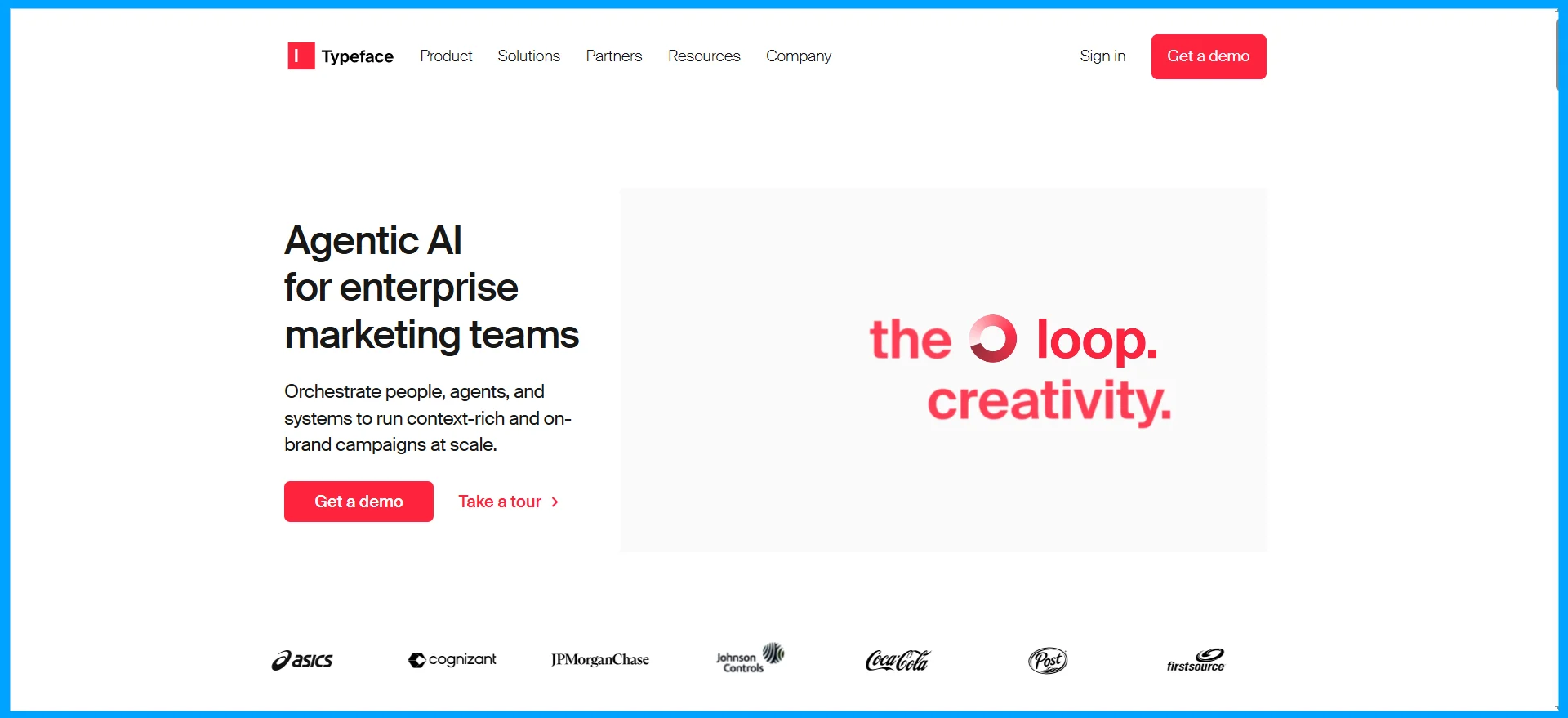
Typeface AI is the best fit if your content operations revolve around campaigns: many versions of the same message for different audiences, channels, and markets. Typeface’s Arc platform has three parts I find interesting:
- Arc Graph turns your brand guidelines into structured rules. Its Brand Agent checks content for brand compliance as it's created and shows which rule is applied, and Arc Graph extends to tools such as Claude and ChatGPT.
- Arc Fabric is the workspace and runtime where people and agents create together, with governed access, reusable skills, and connections through MCP, APIs, and webhooks.
- Arc Loop feeds campaign results from tools such as Google Ads, Salesforce Marketing Cloud, and HubSpot back into Typeface, so the next campaign learns from the last one, with human approval before publishing.
Typeface AI also works inside Figma, Photoshop, and Illustrator, and its customers include names like J.P. Morgan, Johnson Controls, Chime, ASICS, and State Farm. According to Typeface's newsroom (opens in a new tab), Typeface's Orchestration Engine won ADWEEK's 2026 Tech Stack Award for agentic AI.
Typeface AI Security
According to Typeface’s security and governance page (opens in a new tab), it is SOC 2 Type II, ISO 27001, and ISO/IEC 42001 certified, with SSO, role-based access at the organization, team, and user levels, and tenant isolation.
Typeface AI Pricing
Typeface doesn't publish prices or offer a free trial; you book a demo or take a product tour. Although there are third-party speculations on what its pricing looks like, I’ll recommend you contact them to find out a custom price for you.
What users say about Typeface AI
Users like its purpose-built marketing agents, no-code Agent Studio, and ability to keep brand guidelines, assets, and campaign knowledge connected. They also appreciate creating custom agents to automate repetitive marketing workflows. The caveat here is that I found limited reviews for Typeface AI on G2, and the few I found looked to me like vendor-sourced reviews.
Typeface: pros and cons
Pros
- Pro: Turns brand guidelines into rules its agents enforce, and shows which rule applied
- Pro: Arc Loop learns from campaign results in Google Ads, Salesforce, and HubSpot
- Pro: Works in Figma, Photoshop, and Illustrator, so it covers creative assets as well as copy
- Pro: SOC 2 Type II, ISO 27001, and ISO 42001 certified
Cons
- Con: No published pricing or free trial
- Con: Few public user reviews
- Con: No AI search visibility tracking or website refresh workflows
- Con: Built for large enterprises, so mid-size teams may find it more than they need
My recommendation
Choose Typeface if you're an enterprise brand that personalizes campaigns across many channels and wants creative and copy governed by the same brand rules. For website content and AI search, AirOps covers ground Typeface doesn't.
5. Optimizely Content Marketing Platform: the best for planning, approvals, and assets
Optimizely CMP
Best for planning and approvalsOptimizely's Content Marketing Platform brings campaign planning, shared calendars, intake requests, approval workflows, and a digital asset library into one system, with Opal AI agents built into the workflow.
- Best for
- Enterprise marketing operations teams that coordinate many contributors, approvals, and assets
- Price
- Custom (individually packaged)Checked 31 Oct 2026. Prices can change.
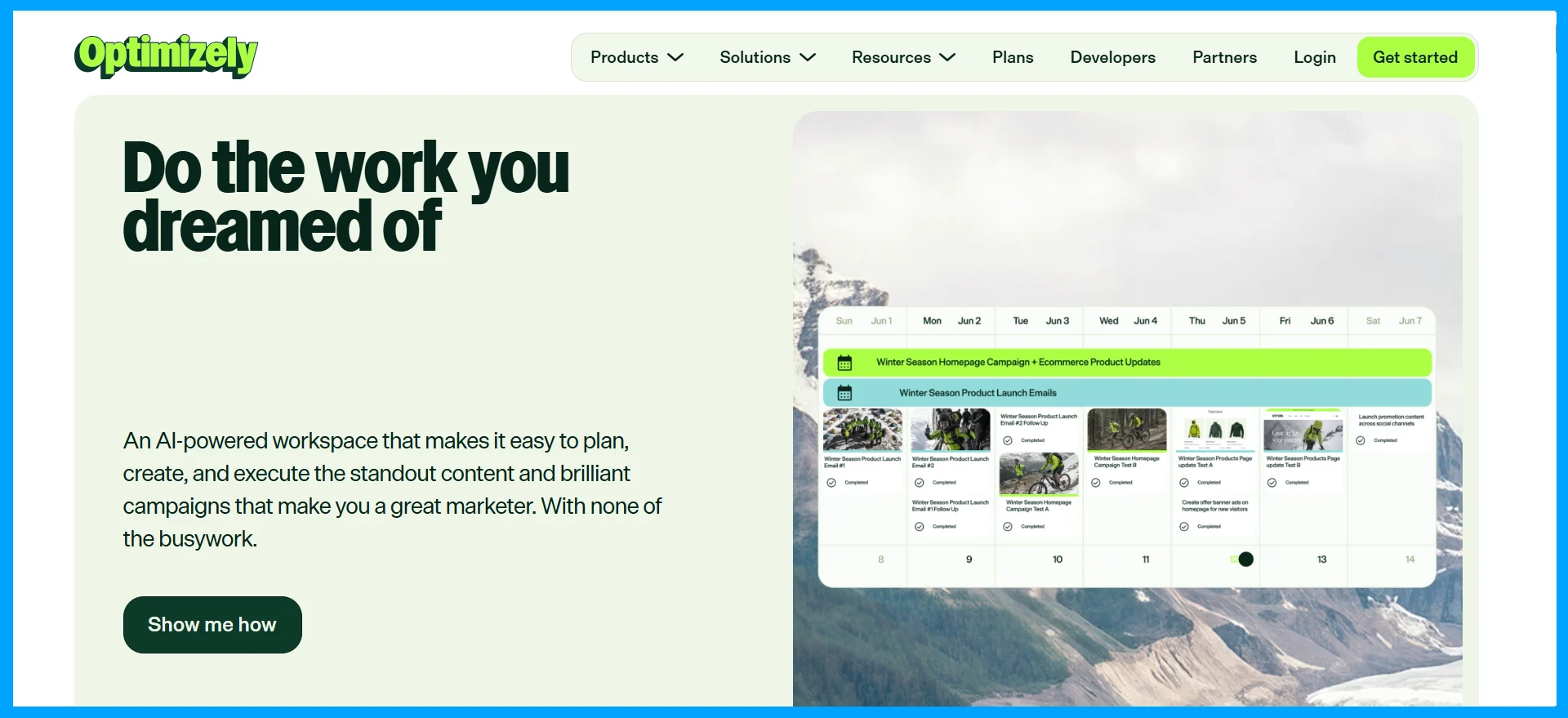
Optimizely's Content Marketing Platform (CMP) is the right pick when the slowest part of your content process is coordination: requests, briefs, reviews, approvals, and finding the right asset. It gives teams shared calendars, automated intake requests, approval workflows, and one marketing-approved asset repository, so work stops getting lost in email and spreadsheets.
The platform’s AI is powered by Optimizely Opal, an AI and agent orchestration platform built directly into the Optimizely One digital experience and marketing product suite. Powered by Google Cloud and Google Gemini, Opal acts as a central intelligence layer designed to automate and streamline the entire marketing lifecycle.
Agents inside CMP workflows draft and localize content, generate campaign briefs, run brand and compliance checks, and suggest existing assets so teams don't duplicate work. Optimizely's Agent Platform offers more than 50 ready-made agents, including GEO recommendations and virtual teammates. Virtual teammates are role-specific AI digital coworkers such as a Content Marketer, an SEO, an AI Search Analyst, etc., designed to act as real members of your marketing team rather than just on-demand chat prompts. I like that Optimizely CMP connects to Salesforce, Conductor, and Google Analytics.
Gartner named Optimizely (opens in a new tab) a Leader in its 2026 Magic Quadrant for Content Marketing Platforms, the ninth year in a row. Some of the platform’s customers include Shell, The Royal Mint, Diligent, Ryder, and RAKBANK.
Optimizely CMP Security
Optimizely CMP offers enterprise-focused security, with SOC 2 Type 2 attestation, encryption, role-based access controls, data segregation, support for SSO through SAML 2.0, and two-step verification. It also conducts regular security assessments and penetration testing. I still recommend that you verify AI data handling, retention policies, permissions, and compliance requirements before deployment.
Optimizely CMP Pricing
Optimizely doesn't publish prices for its plans. Every plan is individually packaged, and you request a demo to get a quote.
What users say about Optimizely CMP
Optimizely CMP holds 4.3/5 from 81 reviews on G2. Reviewers appreciate its centralized campaign management, customizable workflows, content calendars, task tracking, and collaboration features. It helps teams manage multiple campaigns, stakeholders, and approval processes in one place. However, reviews mention a steep learning curve, challenging setup, occasional glitches, and limited customization.
Optimizely CMP: pros and cons
Pros
- Pro: Planning, intake, approvals, and asset management in one system
- Pro: Opal agents work inside the workflow: briefs, drafts, localization, and compliance checks
- Pro: A Gartner Magic Quadrant Leader for content marketing platforms for nine years running
- Pro: Fits naturally if you already run Optimizely CMS, experimentation, or personalization
Cons
- Con: No published pricing or free trial
- Con: Its AI agents are newer than its core workflow tools
- Con: AI search support is limited to recommendations, not full visibility tracking
- Con: A large platform to roll out, best suited to enterprises with a marketing operations team
- Con: Has a steep learning curve.
My recommendation
Choose Optimizely CMP if you need to organize the people and approvals behind your content more than you need to produce more of it. Many teams pair a planning platform like this with a production platform like AirOps.
How the platforms compare on enterprise requirements
AirOps, Jasper, WRITER, and Typeface all list SOC 2 Type II, so security alone rarely decides it. The bigger differences are in AI search visibility, publishing, and how much you can learn before a sales call.
Requirements | AirOps | Jasper | WRITER | Typeface | Optimizely CMP |
|---|---|---|---|---|---|
SOC 2 Type II | Yes | Yes | Yes (includes HIPAA) | Yes | Yes |
Other certifications | Not listed (learn more on their security and compliance page) | GDPR and CCPA compliance | ISO 27001, 27701, and 42001, HIPAA type 1. | ISO 27001 and 42001 | ISO 27001, ISO 27017, ISO 27018, PCI-DSS, HIPAA, and GDPR |
SSO | Yes (Okta, Azure AD, Google Workspace) | Business plan (SAML 2.0) | Enterprise | Yes | Yes (Azure AD, Okta, Google, Duo, PingOne, PingFederate, and OneLogin) |
Role-based access | Enterprise plans | Admin controls and Groups (Business) | Enterprise | Organization, team, and user levels | Yes (across the entire product suite) |
No training on your data | Stated | Stated | Check the contract | Full ownership of inputs and outputs stated | Stated |
Brand governance | Brand Kits and Knowledge Bases | Brand IQ, Product IQ, and Knowledge | Brand governance and Enterprise Brain | Arc Graph and Brand Agent | Brand and compliance agents |
AI search visibility tracking | Yes, 10+ engines on Pro, with Search Console and GA4 data added for enrichment | GEO Hub and GEO Agent | No | No | GEO recommendations |
Bulk processing | Grids (hundreds of rows) | Jasper Grid | Agents and Playbooks | Arc Fabric agents | Workflow automation |
Publishes to your CMS | Six native CMS integrations plus API | Via integrations and API | Via integrations | Via MCP, APIs, and webhooks | Optimizely CMS and others |
Published price | Not publicly (trial gets you started) | Pro only | Starter only | No | No |
How much do AI content operations platforms cost?
Expect to talk to sales for any platform on this list at mid-size or large company scale. Only Jasper (Pro) and WRITER (Starter) publish entry prices, and those plans are for small teams.
Platform | Self-serve entry | Team or enterprise plan | Free trial |
|---|---|---|---|
AirOps | Solo: 35,000 tasks a month, 1 user ($200/month) | Pro: 100,000 tasks, unlimited seats ($2,000/month); Enterprise: custom | 14 days, no card |
Jasper | Pro: $69/seat/month, or $59 billed annually | Business: custom, 12-month commitment | 7 days (Pro) |
WRITER | Starter: $39/user/month, or $29 billed annually | Enterprise: custom | Yes (Starter) |
Typeface | None | Custom | Not listed |
Optimizely CMP | None | Custom, individually packaged | Not listed |
Two cost traps to check before you sign.
First, usage-based billing: AirOps charges per task, and extra tasks on Solo cost $0.025 each, so run your real workflows during the trial to see gauge how fast you exhaust your tasks. That’ll help your budgeting.
Second, the features you saw in a demo or trial may sit on a higher plan: Jasper's Grid, custom agents, and SSO are Business-only, and AirOps' trial includes more features than Solo does.
Why mid-size and large companies need content operations, not just AI tools
Most companies already use AI to create content, but far fewer are getting better results from it. According to the Content Marketing Institute and MarketingProfs' B2B Content and Marketing Trends: Insights for 2026 (opens in a new tab), 95% of the 1,015 B2B marketers surveyed say their organizations use AI-powered applications. Among those using AI for content creation, 87% report improved productivity, but only 39% say content performance has improved.
As someone knee-deep in AI content operations, I can tell you for free that faster drafting doesn't fix a broken content process or poor performance. This is why two teams can use the same AI writing tools but get completely different results. The difference often comes down to how well they've structured their content operations.
Teams getting better results understand that research, audience insights, brand context, content creation, optimization, approvals, and performance measurement must work together. AI should improve not just how quickly you produce content but also its quality, relevance, and business performance.
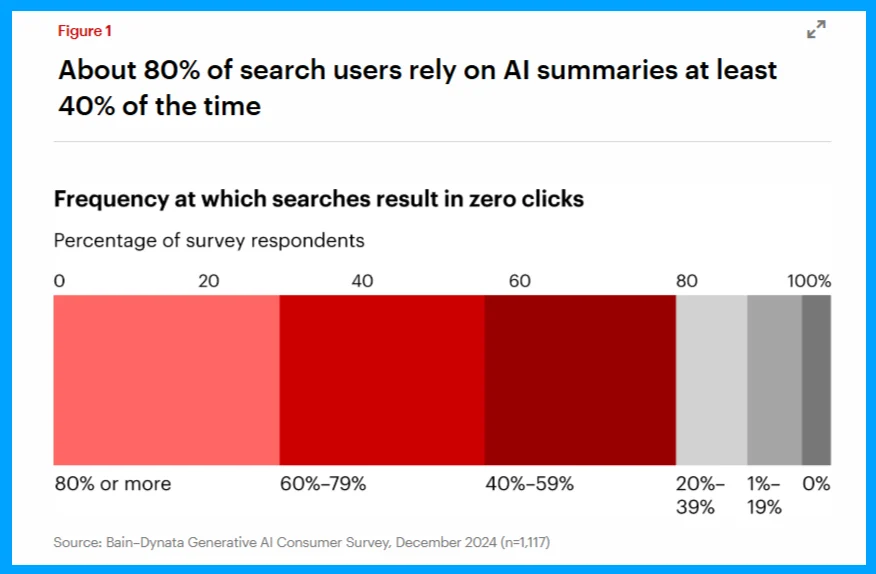
The stakes are also rising in search. According to Bain & Company's Goodbye Clicks, Hello AI: Zero-Click Search Redefines Marketing (opens in a new tab), approximately 80% of the 1,117 consumers surveyed rely on zero-click results, including AI Overviews and chatbot answers, for at least 40% of their searches.
Meanwhile, AirOps' The 2026 State of AI Search (opens in a new tab) found that only 30% of brands remained visible from one AI-generated answer to the next. For companies managing hundreds or thousands of content assets, maintaining visibility requires regular, systematic content monitoring and refreshes, not occasional rewrites.
This is where content operations platforms become important. If you have multiple teams producing content across regions, products, and channels, you need shared brand guidelines, reliable knowledge sources, repeatable workflows, approval processes, and performance measurement. A collection of standalone AI tools won't necessarily give you that.
For mid-size and large enterprises, a good AI content operations platform helps with:
- Consistency and governance: Maintaining brand messaging, quality standards, and approved information across teams.
- Operational efficiency: Automating repetitive tasks and reducing manual handoffs.
- Scalability: Running workflows across hundreds or thousands of content assets.
- Collaboration and accountability: Connecting content, SEO, product, sales, and marketing teams.
- Content quality and accuracy: Grounding AI outputs in company knowledge, research, and customer insights.
- Performance measurement: Connecting content activities to visibility, citations, conversions, leads, and pipeline.
How to choose the right AI content operations platform
The right platform is the one that fixes your team's slowest step. Ask these five questions:
- What's your main bottleneck? If it's tracking performance in AI search engines and producing and refreshing website content that wins in search and AI search, choose AirOps. If it's keeping campaign content on-brand across markets, choose Jasper. If it's planning and approvals, choose Optimizely CMP.
- Is your content mostly web pages or mostly campaigns? For web pages, blogs, help content, and emails, I’d recommend AirOps. If it’s Ads, social, and creative across many audiences, I’d say go with Typeface or Jasper.
- Do you need to see results in AI search? AirOps and Jasper both track AI visibility now. AirOps covers 10+ answer engines on Pro and adds the data from each page's Search Console and GA4 numbers to give you more context. This matters most when your goal is website traffic.
- Who will own the setup? Every platform here needs someone to help you set it up, build the brand context, add knowledge bases, and build the first workflows. Budget three to four weeks and name an owner before you buy.
How to roll out an AI content operations platform
A rollout that pays off usually takes about a month and follows the same steps, whichever platform you choose:
- Pick one high-volume process. Content refreshes, product pages, or campaign localization work well because they repeat and their results are easy to measure.
- Build the brand context first. Load your voice, style guide, product facts, and approved sources and materials before you run a single workflow. Output quality depends on it.
- Add human review steps. Decide who approves what, and hold content in draft until it's approved.
- Build your workflows: Build your workflow and/or playbook and include all necessary brand kit, knowledge base, and human review steps.
- Run a pilot on 10 to 50 items. Compare time spent, edit rate, and results with your manual process.
- Measure, then expand. Track output per person, time to publish, organic traffic, and AI citations, then audit and expand where necessary.
About content quality: Google rewards helpful content, regardless of how it's produced. Google Search's guidance about AI-generated content (opens in a new tab) says that using automation, including AI, to generate content mainly to manipulate search rankings violates its spam policies. A platform with brand context and human review steps helps you stay on the right side of that line.
Which AI content operations platform should you choose?
Verdict: AirOps
Recommended with caveatsAirOps is the best AI content operations platform for mid-size and large companies whose content has to win in search and AI search. It tracks how 10+ answer engines cite you, ties that to each page's Search Console and GA4 data, and runs the workflows, grids, and agent that brief, write, refresh, and publish the fixes, with SOC 2 Type II, SSO, role-based access, and review steps for enterprise teams. Its prices start from $200/month, there is a task-based billing that takes a trial to forecast, and you should plan for about 2 weeks of setup.
- Best for
- In-house content and SEO teams at mid-size and large companies that publish or refresh dozens of pages a month
- Avoid if
- Your content is mostly multichannel campaigns and creative, you mainly need planning and approvals, or nobody on your team can own the setup
Choose AirOps if your content team is measured on organic and AI search growth and you want one platform to find the gaps, fix them at scale, and publish the updates.
Choose Jasper if your main problem is keeping campaign content on-brand across a large marketing team, many channels, and many languages.
Choose WRITER if compliance decides your AI tools, or you want governed AI agents for marketing and other departments on one platform.
Choose Typeface if you run personalized campaigns across ads, email, web, and social and want copy and creative governed by the same brand rules.
Choose Optimizely CMP if planning, intake, approvals, and asset management slow your team down more than writing does.
Choose more than one if you're a large enterprise: a planning platform such as Optimizely CMP alongside a production platform such as AirOps is a common setup.
My suggestion for getting started: take the AirOps free trial, connect Search Console and GA4, and pick 20 pages that rank in Google but aren't cited in AI answers. Run one refresh workflow on them with human review, and compare the time spent and the results after two weeks with your last manual refresh.
Frequently asked questions about AI content operations platforms
What is the best AI content operations platform for enterprises?
AirOps is the best AI content operations platform for most mid-size and large companies because it combines AI search visibility tracking, AI workflows that create and refresh content at scale, enterprise security, and publishing to your CMS. Jasper is better for brand-governed campaign content, WRITER for regulated industries, Typeface for multichannel campaigns, and Optimizely CMP for planning and approvals.
What is AI content operations?
AI content operations is the practice of running content work as a repeatable system with AI: your brand knowledge, AI models, automated workflows, and human review in one place, so a team can plan, produce, refresh, govern, and measure content at scale. AirOps calls this content engineering.
What is the difference between an AI content operations platform and an AI writing tool?
An AI writing tool drafts one piece at a time from a prompt. An AI content operations platform holds your brand rules, runs multi-step workflows across hundreds of pages or assets, adds approval steps, publishes to your CMS, and measures results.
Is AirOps better than Jasper?
AirOps is better for website content that needs to win search and AI search because it tracks AI citations across 10+ engines on Pro, adds Search Console and GA4 data to each page, and runs refresh workflows across hundreds of pages. Jasper is better for campaign and marketing copy across many channels and languages, and it just added AI visibility tracking with its GEO Hub in June 2026.
Is AirOps good for large companies?
Yes. AirOps lists SOC 2 Type II certification, SSO through Okta, Azure AD, and Google Workspace, role-based access and SCIM on enterprise plans, human review checkpoints, and native publishing to six CMS platforms. Customers on its site include large companies like Ramp, Chime, HubSpot, Carta, Wiz, and Canva.
How much does an AI content operations platform cost?
Most enterprise plans are custom-priced. Jasper Pro costs $69 per seat a month ($59 billed annually) and AirOps offers a free 14-day trial; in my AirOps review, I found Solo starts at $200 a month and Pro at $2,000 a month. Typeface and Optimizely CMP are quote-only.
Will AI-generated content hurt my Google rankings?
Not if it's helpful. Google says it rewards high-quality content, however it's produced, but using AI mainly to manipulate rankings violates its spam policies. Brand context, human review, and original information keep AI-assisted content useful. You should also have content and SEO personnel review your content before they go live.
How long does it take to implement an AI content operations platform?
Plan for about three to four weeks to set up brand context, connect your CMS and analytics, and build the first workflows. This can take as little as 3 days if you're already familiar with the platform.
Sources
- AirOps: Pricing (opens in a new tab)
- AirOps: Enterprise (opens in a new tab)
- AirOps: Webflow Accelerates Content Refresh 5X and Increases AI-Sourced Signups in Days (opens in a new tab) (June 11, 2026)
- AirOps: The 2026 State of AI Search (opens in a new tab) (December 2, 2025)
- G2: AirOps reviews (opens in a new tab)
- Humans of Martech #220: Alex Halliday on content engineering systems (opens in a new tab) (May 19, 2026)
- Jasper: Pricing (opens in a new tab) and Jasper homepage (opens in a new tab)
- Jasper: Introducing Jasper GEO Agent and GEO Hub: End-to-End AI Search Optimization (opens in a new tab) (June 16, 2026)
- G2: Jasper reviews (opens in a new tab)
- CMSWire: WRITER Releases Palmyra X6, Upgrades Enterprise AI Agent Platform (opens in a new tab) (August 14, 2026)
- CMSWire: WRITER launches Enterprise Brain to unify AI agent context (opens in a new tab) (September 9, 2026)
- Amazon: Writer Releases New Adaptive Reasoning LLM Palmyra X5 With 1M Context Window (opens in a new tab) (April 28, 2025)
- WRITER: ISO certifications and Trust Center (opens in a new tab) (May 2025)
- WRITER: Plans (opens in a new tab)
- Typeface: Homepage (opens in a new tab), Security and governance (opens in a new tab), and Newsroom (opens in a new tab)
- CMSWire: Typeface Launches the Next Generation of its Orchestration Engine (opens in a new tab) (September 22, 2026)
- Optimizely: Content Marketing Platform (opens in a new tab), Agent Platform (opens in a new tab), and Plans (opens in a new tab)
- Optimizely: Optimizely Recognized as a Leader for the 9th Year in a Row in Gartner Magic Quadrant for Content Marketing Platforms (opens in a new tab) (April 7, 2026)
- G2: Optimizely Content Marketing Platform reviews (opens in a new tab)
- Content Marketing Institute and MarketingProfs: B2B Content and Marketing Trends: Insights for 2026 (opens in a new tab) (October 8, 2025)
- Bain & Company: Goodbye Clicks, Hello AI: Zero-Click Search Redefines Marketing (opens in a new tab) (February 19, 2025)
- Google Search Central: Google Search's guidance about AI-generated content (opens in a new tab) (February 8, 2023)